Wednesday, August 22, 2012

Column of Heaven interview


Column Of Heaven interview - Incidental Afterthought zine #15, February 2012 (Philippines)

INCIDENTAL AFTERTHOUGHT: Like most new bands I discover (especially on my own), how and when did Column of Heaven start? Current line-up?  

COLUMN OF HEAVEN: Nothing very interesting to tell, current line-up is King. Kristiansen. Nolan. Simpson. Formed in our minds 2010, but didn’t even rehearse until 2011.

Three of us have played in various bands together for a few years now (The Endless Blockade, Slaughter Strike, Death Agonies and others).

Simpson is someone I’ve known for a while; we asked him to play guitar when Ward had to leave the band.

IA: You've stated on your blog that shows won't be a regular thing with Column of Heaven, too. Do you guys live in different cities/countries from each other?

COH: Quite by accident we all live pretty close to each other. A lack of regular live outings is mostly due to a lack of time, frequently due to a lack of energy, and definitely due to a lack of money.

I find the more I play songs live the less invested in them I am; it's almost as if they're (the songs) moving too far away from their initial spark of creation for me to remain interested in them.

Every band I've ever played in has retired songs from the live set fairly quickly once new ones are written.

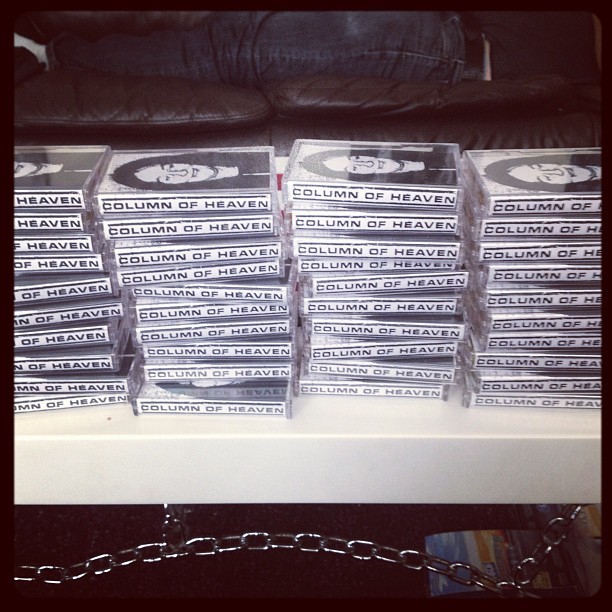
IA: I really admire your generosity of spreading your music by posting it on your blog (complete with its artwork cover and lyrics, too), but the tape copies sold out fast. I guess my question is, Column of Heaven has shown (in my eyes at least) a total passion toward DIY underground by releasing its music first in tangible form (cassette tape), and then after it all sold out, gives it literally for free online. That's the idea of why I really like the underground network of DIY-released music, the idea of communal ideas, not just being entertained; however, as you might have known, I'm sure, people have developed an attitude that's sheep consumerism in nature, so to speak. What are your thoughts as to why underground music in general (not just hardcore) have been plagued by this (for example, shitty bands releasing 3-colored versions of their 7"s that goes for insane amounts on Ebay; people buying records for the 'bragging' entitlements due to limited copies/rare color, etc.)?

COH: OK, I’ll try and answer this question as best as I can. I think I read four points here; one about giving our music away for free, one about music – or more specifically the culture of music – not just being entertainment, one about consumerism in the underground and a final one about the politics of limited edition releases, which to me has two different responses, depending on whether or not it’s from a creator or consumer perspective.

I posted the Ecstatically Embracing release online once I'd sold all the copies that we made (200 in total). I'd sold all the copies we made and even if I was completely precious about limited releases being only heard by the 200 people that bought them – which I'm not – I can't stop people uploading it so others can download it.

If I can't stop people downloading it for free then I may as well make it available in a lossless format, not some awful lo-bit rate rip done on substandard equipment. And if everyone did this with their music eventually download blogs would die out because there would be no need for them.

Yes, we're totally committed to DIY principles, less out of any flag waving, chest beating idealism, and more because we realize that most of the time it's easier and more gratifying if we do it ourselves. This is also the approach we take with live shows, we'd rather only work with one or two local promoters or just book everything ourselves. Basically, our band is something that's important to us, so we don’t leave it at the mercy of people not up to the job. Obviously nothing's set in stone and compromises have to be made sometimes.

The value that I place in music is primarily in the culture that surrounds music; nothing happens in a vacuum. That cultural sphere isn't really "entertaining" in any traditional sense, but something has to bring you in to that sphere. If there's nothing entertaining about music, no one's going to care about it, people don't just like Whitehouse because it makes them uncomfortable after all. Most people don't think this way and that's fine, I know what my motivations are and where my passions and interests lie, if someone else is into whatever they're into purely because it feels good then that's absolutely valid as well, but in any underground culture – by which I mean any art form that does not have money as its motivator – there's always an extra level beyond the superficial aspects. Part of the struggles are always who has the right to interpret what that extra level means, see any discussion about Liturgy and whether or not they're actually black metal for example.

If we can think of underground music in terms of having multiple levels of meaning to it – even if you don't agree that music means anything beyond the sound itself there are people in the world that act as if it does – then there are multiple ways that people extract that meaning. One of the ways of extracting deeper meaning is always going to be through ownership; music means more than just sound, music creates artefacts like records and shirts, those artefacts are sometimes consumed because it is believed that they contain the essence of that extra meaning. To put it more simply; sometimes people buy things because they think it gives them a higher status in whatever hierarchy they operate on.

To get to the final point and try and connect this back again (thanks for your patience). Bands create limited editions for a number of reasons. One of those is because music doesn't sell very well anymore so you have to "force" the hand of the consumer to buy directly from you and not from a distro or store. At shows bands sell merch primarily because they need money to put into their gas tank. If you sell a 7" with a limited sleeve only available from you at that show, then you're more likely to sell them than if people can buy them online. And if limited editions give bragging rights (as you identify): "that's cool that you downloaded the entire back catalogue of [insert band name], but I own this record and you'll never even see a copy of it."

At its most simplistic level, limited releases for the band it's just another tool of for selling music, for the consumer it's a way of feeling a closer connection with that band by "owning" a part of their creation.

IA: I really like the Noise-aesthetics that Column of Heaven incorporates into its music. I know this might be incorrect to some but your music truly sound unique and innovative because of this. Was this incorporation of approach consciously in the band or did it just come naturally? (I love your Joshua Norton Cabal Inner Light CD by the way, great forward-thinking stuff)  

COH: Thanks for your kind words. The addition of noise isn't really for any goal of uniqueness or innovation; it's just something that makes sense. Non-traditional sound as music ("noise" etc) has been a part of my sonic interests for as long I've been interested in music. The recording process is still another compositional step as far as I'm concerned, so I use the recording time to figure out if there's anything else I can add to a piece before walking away from it forever (bar performing those songs live of course).

IA: How is Column of Heaven's music/song writing-process? Is it in a collaborative way or is there a main-songwriter?   

COH: It’s pretty much a benevolent dictatorship really; I write all the music, though there’s a loose process with King where we talk in incredibly vague terms about what we want to do before I go off and write it all.

At this point I haven’t played with another drummer for seven years now, so we’re pretty in tune with each other’s style and approach to music. 

Having input from the rest of the band is important, but I’m not really a fan of collaborative writing; it’s just not how I work. I think all bands need one, at most two, people directing the music, but everyone needs to be on the same page and trust that the person whose responsibility it is to do the music, or aesthetics, isn’t going to fuck it up.

The actual music writing process is undoubtedly boring as hell to outsiders, but I’m pretty much writing exclusively in additive rhythms these days, I like the dissociative aspects of that kind of playing.

"Jamming" is something I can't get my head around; to me it's like aimlessly doodling with a pencil and hoping to come up with the Mona Lisa. There was only one Austin Osman Spare after all (and he worked alone anyway).

IA: Your lyrics on Ecstatically Embracing all... are very powerful in their own. I am a big fan of poetry/prose as well and  I get a different kick when I read lyrics of a band I like musically; it's like hitting a mental bird with two stones. Are your lyrics in Column of Heaven a collaborative effort as well? Are they written together with the music or independently from it? 

COH: I was handling all the vocals on the demo, so I wrote all the lyrics, Kristiansen is doing that now and it's better if he writes the lyrics from this point on. We talk about concepts and directions, but the ultimate form the lyrics take are going to be his sole responsibility from here on in. As much as it might pain me, I can't control every single aspect of the creative process, otherwise people would get fed up and leave.

I try to operate on a level where there's a clearly defined aesthetic and consistency to each release, musically and lyrically, so it's important for me that we get that right. Most people don't care about lyrics anymore, and who can blame them really, most of them are trite at best and garbage at worst. Which isn’t to say I see myself as some kind of Oscar Wilde of hardcore, far from it, I feel everything I write falls short of what I actually want to say, thanks for the compliment though.

IA: It is very difficult (literally) to get into the kind of reading like Howard Bloom here in our country and it could be because of a combination of geography and access per se (even in the advent of the internet). I eventually have been looking up Howard Bloom's work because of Column of Heaven when you sampled him on your song "The Future Of War" and I must say that as I grow older, getting into underground music still feels very rewarding and profound to me on a personal level (on top of the music kick I get; never the color of vinyl, scarcity of CD run, etc). Do you still feel the same as well when in a similar situation (of getting into a newly-discovered band I mean)?

COH: I’m still very much enthralled by music and literature and have never really gown out of that sense of marvel at coming across something new and exciting. I’m not rabidly enthusiastic about everything I hear, but I’m perpetually being introduced to, or finding, music and writing that gives some sense of perspective and meaning to my life.

IA: Lastly, could you tell me something about your upcoming releases? Any plans for a full-length album perhaps?

COH: We’re currently working on our second release, Mission from God, SPHC from Washington DC is releasing it as a 12”; we’ve struggled to find the time to get together and track the drums, but since starting this interview we found the time to get the drums done.

After that we’re doing a split 7” with Drainland from Ireland [Radioactive Vomit] and a 7”, called Of Dogs and Wolves, on English label Hemlock 13. I’ve written bits and pieces for those two records but want to get Mission from God out of the way before I start thinking about those.

There’s talk of a full length with a label I’ve worked with in the past, I feel like I need to get a few shorter records out of my system first before I try and tackle another full length, it’s been a few years since I had to write one.

Tuesday, August 14, 2012

Armed with Anger: how a young man from Leeds survived the 90s

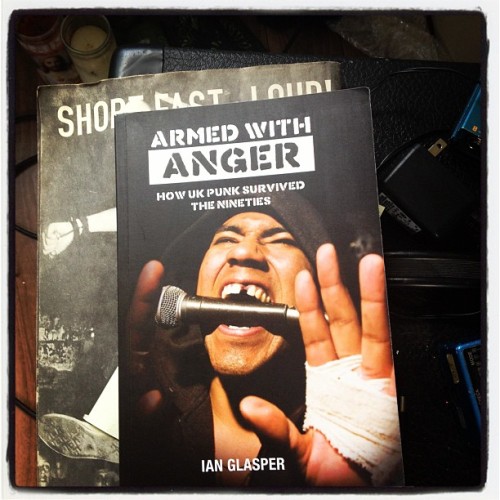
Thanks to a very nice person in Ireland i received a copy of Ian Glasper's latest book, Armed with Anger; How UK Punk Survived the Nineties in the mail today. Shank, the band i was in before moving to Canada, and the band that informed the earliest beginnings of The Endless Blockade has a segment in the book.

Because i've been around for a while i frequently get asked in band interviews about the differences between hardcore then and now, and the state of the scenes in both Europe and North America. It's hard to adequately explain it to people under the age of 30 and i generally just dismiss the question with some kind of "there were terrible bands then and there are terrible bands now and there were life changing, vital, incredible bands then and there are life changing, vital, incredible bands now" response.

The pieces i can't get across to others are how i situated myself in the world as a depressed, angry, anti-social youth compared to the more reasonable grown-ass man i am now, or how information travelled and how we decided which things were significant and meaningful before the internet explosion of the last decade (or more, depending on where you lived in the world).

Lately i've been thinking a lot about what makes my connection to underground (ie not concerned with money) music and the culture surrounding it so important to me. One of the main ways i've been framing the question to myself is "what are the differences and what are similarities in my approach as, say, a 24 year old  - the age i was when Shank began - and as a 39 year old"?

I don't really have any answers to share with anyone else, except maybe privately among the other ex-members of Shank, Ebola and Sawn Off; my unholy trinity of 90s bands.

A part of me thinks this is my version of a mid-life crisis, where i second guess my motivations and frequently feel weird because i'm 20 years older than most people that come to see my band play in. Sometimes i look for reasons to give up making music. After Mission from God came out i told myself that as soon as i can  take the music i hear in my head and accurately reproduce it for others i'll stop making music.

In a way i'd love for this to happen, but i know i'm never genuinely 100% satisfied with any thing i release.

The only thing the above rambling has to do with the Glasper's new book is that reading about, and consequently remembering, the roots of some of the things i do now now and what they meant to me a long time ago has only added fuel to the fire of these thoughts and ruminations.

I don't envy Glasper putting this book together; it can't be all things to all people. What he's chosen to include and exclude are not always the things i would have chosen to include or exclude. And that's the thing about the pre-internet era, there was no real consensus for deciding what was significant and meaningful in the way there is now.

What was important to a person in Newport was not necessarily transferable to a kid from Wigan or Sunderland. I think Glasper is 100% correct to include a band like Bloodshot in the book. Bloodshot only released a handful of tapes and left almost no legacy, but they epitomised the drive and spirit to get out there and create some kind of meaningful experience for themselves. They toured far more than any of my bands ever managed and all of my bands were "big shots" with crappy split 7"s that we could trade for other crappy split 7"s.

But at the same time i look at the contents and wonder why Nailbomb are mentioned only in passing and stuff like Bus Station Loonies, Whippasnappa, Chineapple Punks, or Demonic Upchucks get sections in the book. Part of this is because i don't place any value in those bands, but there are lots of bands in the book that i don't care for that are absolutely essential in telling the story of UK hardcore punk in the 90s.

Like i said, there wasn't really a way of achieving consensus in the pre-internet era on who was important beyond who had records out. Glaspers experiences are not going to be even remotely similar to my own

I suspect that for anyone who wasn't there there's only really a small segment of this book that will be interesting to read, but as much as i hate nostalgia (and i'm not really convinced this book is merely nostalgic) i'm really glad it exists.

And fuck, i know a lot of dead people. RIP Jas Tommer, Lobster and a ton of other people, some of whom i didn't know were dead until i flicked through the book.

A half arsed list off the top of my head of some records from that time and place that  i think are essential:

Downfall - Not Your Fault 7" (1992)
Nerves/ Substandard - split 7" (1995)
Hard to Swallow/ Underclass - split 7" (1996)
Health Hazard - Not Just a Nightmare 7" (1993)
Wartorn - Banzai 7" (1994)
Urko/ Minute Manifesto - split LP (2001 - though both are most definitely 90s bands)
One by One - Fight 7" (1992)
Disaffect - An Injury To One Is An Injury To All 7" (1992)
Voorhees - Spilling Blood Without Reason LP (1994)
Kito - the Long Player LP (1998)
Ironside - Fragments Of The Last Judgement 7" (1993)
Stalingrad - Politics of Ecstasy 7" (1996)
Kitchener - The Price Of Progression 7" (1993)
Fabric - Body of Water LP (1994)


Monday, July 30, 2012

between now and 2013

These are the only musical things i am doing between now and next year:

Shows:

Column of Heaven, Purity Control, Farang, Spearhead, September 7th at 460 Spadina, Toronto

Column of Heaven, Magrudergrind, Iron Lung and others, Saturday, November 10th at Hard Luck, Toronto

Pick Your Side European tour October 12th-21st

If The Process manage to make it to this part of the world in late October Column of Heaven will be playing with them in Toronto and Montreal

Releases on Survivalist:

The Rita - new C20
Column of Heaven - Demonology CS

There might be a Colonizer tape as well, but that might not happen until next year.

Some books i've enjoyed lately:

Zack Furness (ed) - Punkademics: the basement show in the ivory tower

Stephen Duncombe and Maxwell Tremblay (eds) -White Riot: Punk Rock and the Politics of Race

Clifford A. Pickover - Sex, Drugs, Einstein, & Elves: Sushi, Psychedelics, Parallel Universes, and the Quest for Transcendence

Jack London - Iron Heel


Tuesday, July 17, 2012

a word on downloads

I can't stop them, i'm not really going to try, but here's my request as an artist: If it's on the bandcamp page, please don't upload it to your blog; people can get it for free from there.

If the free downloads run out then people are just going to have to wait the 1-30 days until the free credits come back. Waiting a few days for a free digital version of a grindcore record won't kill anyone or ruin anyone's day.

If it means less people are exposed to my music i'm ok with that.

If you're going to ignore me completely, then there's not really a whole lot i can do about it; issuing cyber death threats has never really been my thing.

But, if you really are going to upload it anyway, say something about it, put it into some kind of context, good or bad i don't really care.

More than just a picture of a wolf in a heptagram with "ex-The Endless Blockade" and a download link please.

That's it.

(This doesn't apply to anything before Mission from God went up, Slaughter Strike and Ecstatically Embracing... are fair game)

Tuesday, July 10, 2012

Soldiers' Field

Soldiers' Field now online as well

Monday, July 9, 2012

Mission from God LP out now

Order it here

I've seen some internet talk about how this is our death metal record and honestly, if you read that and expect anything beyond one or two harmonised riffs you're going to be spectacularly disappointed.

And if you're a fan of the New Wave of Circus Grind you're definitely going to hate it.

It's now on bandcamp for pay what you want download, though bandcamp has a cap on that stuff, so when the free monthly downloads run out go seek a shit rip from the Bridge Nine board or something.


This record was never supposed to be an LP but it just sort of grew after the Rot in Hell split 7" we were going to do fell apart when they had a line up shuffle.

I wanted to write a record that explored some of the reasons why i'm an unrelenting misanthrope and Mission from God was the result.

In a nutshell i grew up whilst serial killer Peter Sutcliffe was killing women in the part of England i'm originally from; far from being some distant and incomprehensible tabloid tale this was something that seriously affected the social landscape of where i was living that's hard to adequately convey to others.

As a teen a lot of my friends were into dumb shit like reading the book of Revelations and scratching pentagrams in their arms in the late 1980s. Hey, it's what kids did back then, just like how now they post pictures of witches on Tumblr. As a wannabe seventeen year old magician i took a hit of acid and went to Soldiers' Field, where Irene Richardson was killed in 1977, and tried to contact her spirit. It didn't work, at least not in the way i was hoping it would.

We sold an alternate version over the weekend in BC that came with a different cover, a short zine, and a tape called Soldiers' Field which is not a separate release, more of an addendum, mostly, but not entirely, pure noise. I'll put the whole thing up on bandcamp in the next week or two.

Rather than rewrite some stuff i've already gone over here are the two statements that are included in that version of the record, the first by Dave, the second by me:


From 1969 until his arrest in 1981, Peter William Sutcliffe, also known as “The Yorkshire Ripper” attacked and murdered women in Yorkshire, England. The overwhelming majority of his victims were caught in the suffocating poverty that defined much of Yorkshire at the time. Many were involved in the sex trade. All were eventually united by Sutcliffe’s clear and extreme hatred of women which erupted as he bludgeoned, stabbed and beat his victims.

Why write an album about a serial killer? To view this album through such a narrow prism is to miss the point utterly. The absolute last thing we wanted to do with this record was to trot out asinine subgenre clichés; truly, does the world need another grind/noise release that vapidly glorifies sexualized violence? Fuck no. So, then. Why? The answer is primarily catharsis. There are member(s) of this band that experienced life in the time and place of Sutcliffe’s activity. This work is intended to help purge oneself of the poison and unease that comes from growing up in Sutcliffe’s shadow, and to remind oneself of how that environment is inexorably part of our being.

The simpler impetus behind this album is that Sutcliffe’s murders are part of a larger, horrifying landscape… a bleak, ruined vista of grinding poverty, institutionalized racism and sexism, police brutality, pollution and inescapable decay. Quite simply, the Yorkshire of Sutcliffe’s day is probably unimaginable to those who weren’t there. It was a time and place that warrants examination and exploration. The environment of Yorkshire at the time and Sutcliffe’s crimes are deeply interrelated, perhaps even symbiotic. Some of this album is deeply personal, much is intentionally enigmatic and some is completely straight ahead. Our desire is not to decode or spell this album out, but to encourage one to consume it on a level that is deeper than a “fuckin’ grind/noise album about a serial killer, man!”.

In a society that is absolutely saturated in violence, much of it directed towards women by men, it is easy to be unaffected by the truly horrific nature of Sutcliffe’s crimes. Years have passed since then, but the reality is that women violently lost their lives. Some survived attacks by Sutcliffe only to pass their remaining years tormented by trauma, fear and depression. Family members of victims took their own lives. The bureaucratic and police reaction was a disgusting farce: Sutcliffe was interviewed by police nine times and was ultimately caught only by complete accident. The police and powers that be simply didn’t care that someone was murdering poor women. It’s a reprehensible reality that sadly continues today all over the world. It’s a cold, terrible place and will likely always be so.

Kristiansen, Summer 2012


I was born in Leeds, West Yorkshire, England in 1973. Seven years before my birth Ian Brady and Myra Hyndley were convicted of killing children in Greater Manchester, just across the Pennines from West Yorkshire. The bodies were buried on Saddleworth Moor; Keith Bennet, missing since 1964, has never been found.

In 1977 Irene Richardson was beaten to death with a hammer and her corpse mutilated with a knife. The murder took place at Soldiers’ Field, less than a mile from where I lived, and was committed by Peter Sutcliffe, the man this record is superficially about. Between 1975 and 1980 Sutcliffe would kill at least 13 other women, including Jayne MacDonald (1977) and Jacqueline Hill (1980), in areas that would grow to have great significance in my life.

It’s hard to really convey what this record is about succinctly, but for me it’s about how the physical and social landscape shapes us.

My childhood physical landscape prominently featured buried children and murdered women. My childhood social landscape had an inept and brutally racist police force that was both unable and unwilling to protect the women of northern England.

In a way this record is my own exploration of the Greek concept of Pharmakós, the ritual scapegoating of people for sacrifice in times of crisis and upheaval.

The 1970s were a shit time to live in northern England and the first half of the 1980s weren’t that much better. I grew up with garbage strikes, an energy crisis that caused shortages of electricity, economic recession that created a three day working week, mass unemployment, and the gradual nationawide realisation that the days of England’s former colonial glories (add your own sarcastic intonation for the word glories) had finally ebbed away into nothing.

Sutcliffe’s misogynistic rampage across northern England gave us a diversion from all the other shit. It wasn’t until Sutcliffe started making ‘mistakes’ and killing women that weren’t sex workers – and thus disposable – that incompetent police officials like George Oldfield became accountable.

Nolan, June 2012

Further reading:

Derf Backderf – My Friend Dahmer
Michael Bilton – Wicked Beyond Belief: the Hunt for the Yorkshire Ripper
Ian Brady – The Gates of Janus: Serial Killing and its Analysis
David Peace – Red Riding Quartet


Next release is a split 7" with Radioactive Vomit from Vancouver on Feast of Tentacles


Give Up shirt

available here sold out