Friday, December 7, 2012
Column of Heaven interview
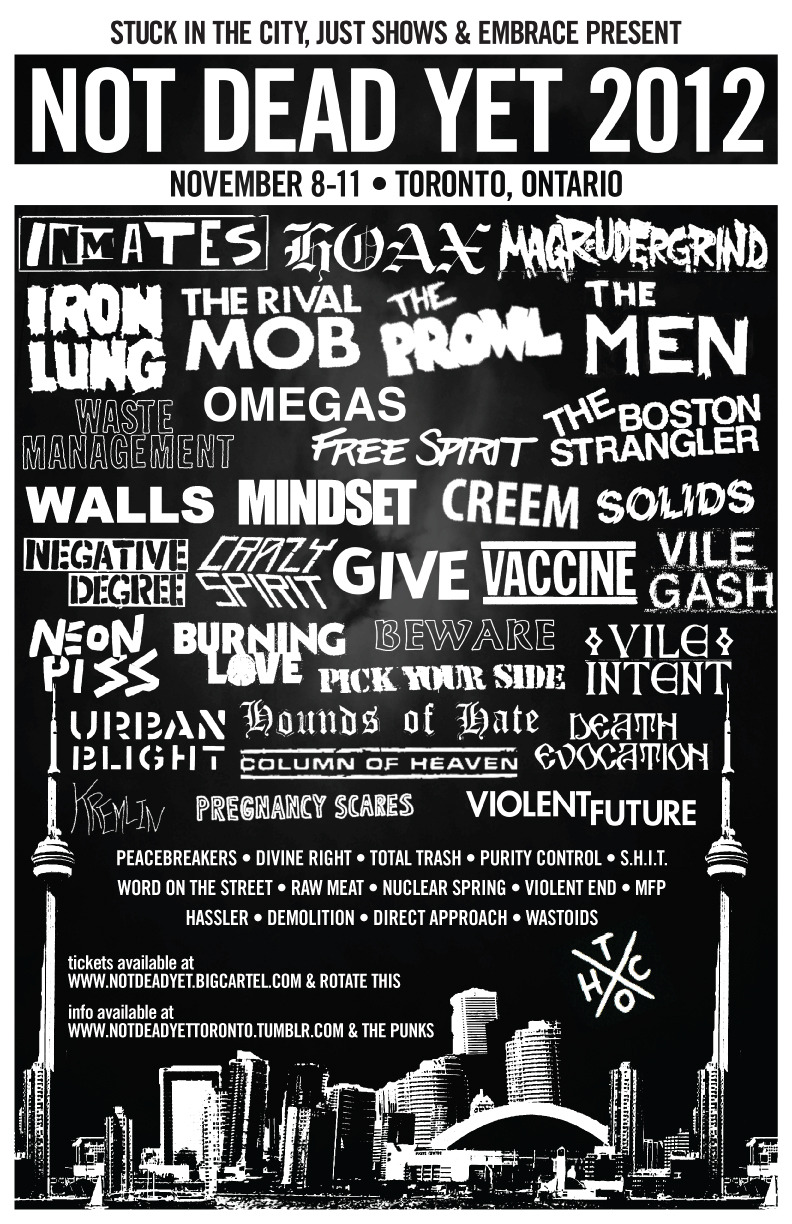
Recent interview done very quickly in time for Not Dead Yet fest
Questions by Payson from Purity Control
How important is it for Column Of Heaven to play live? How do you see the audience's role in a COH set?
I don’t really understand music that makes people want to sing a long and have a good time, consequently have never aspired to make music that inspires that reaction in others. I’m too selfish to think of what the audience should or shouldn’t do.
How has the song writing process changed from the Endless Blockade to COH, if at all?
There hasn’t been a noticeable clean break between how I composed in Blockade and how I compose in CoH, more of a gradual change. If you compare the Blockade/ Unearthly Trance split LP with Turn Illness into a Weapon there’s a noticeable difference.
Pre-2000 I was an incredibly angry and hostile person, frequently I was a complete wanker. In 2003 I moved to Canada and had a kind of honeymoon period where I was relatively OK with the state of the world for a short period of time. Then in 2006 the two single worst events of my entire life happened within a few months of each other and I regressed to being mad as hell about everything again, though in a considerably more manageable way than throughout the 1990s.
An element of my song writing reflects these changes in where I see myself positioned in the world.
How do you see the sound of COH evolving over forthcoming releases?
There’s a split occurring where some of the material I write is meant to be performed live at significant volume and some is meant to be studio only (Entheogen, They Never Learn, the forthcoming 7” on Iron Lung records). In the second style I mostly work solo, have a semi-improvised approach to performance, and use the recording process as a compositional tool.
Ultimately I’m working towards achieving some kind of balance and integrating the two approaches in a more meaningful way beyond either drowning the final mix of a song in noise (the recorded version of the first approach) or replacing all instruments beyond drums and vocals with harsh noise and environmental sounds (characterising the second approach so far).
Who writes the lyrics? Will you continue to write records as conceptual as "Mission From God" was?
Since I stepped down as vocalist Dave writes all the lyrics now. We talk about them a little beforehand, but they’re largely his responsibility. As long as they fit with the agreed upon theme I trust him to take things to where they need to be. I still write the songs I sing on recordings, which are generally the “noise” tracks.
All of our releases will be based on a single theme.
What's the significance of the Smiths lyrics used on the inserts on COH releases? ("Behind the hatred lies a murderous desire for love").
First and foremost just because I think it’s a great line from a great song.
I’ve put a quote on every release that I’ve been on for at least five years now; I usually try and find something that encapsulates where my head is at.
I’m not really interested in single objects; I don’t believe anything exists in isolation from everything else (this is also part of my drive to release themed records from now on). For example I’m not interested in single bands in and of themselves, it’s the connections (or breaking of connections) that makes music interesting to me on a more long term level. A nice song is a nice song for the duration I listen to it and then becomes a part of the void again. I like art that is clearly a reaction – against something, for something; art that stands separate and in opposition to something, that stands alongside other things and makes open allegiances with them (people, concepts, movements).
I like sample based music, hip hop in particular, because it reframes other peoples work and presents it in new forms, early Bomb Squad productions are classic examples of this.
In sampling an out of context line that Morrisey wrote almost thirty years ago I’m weaving him into my own narrative. Mission from God is very much my own narrative of growing up in northern England in the 1970s and 1980s. The Smiths were also a part of that cultural landscape growing up.
The spectre of sexual sadist and serial killer Peter Sutcliffe killing women close to my home deeply affected me and is now a simplified representation of the disgust, deterioration and decay I felt in my early years. He’s a convenient human shaped symbol of everything that’s hopeless and shit in the world.
The Smiths lyric is just another convenient symbol in this context.
Most underrated record in recent memory? Feel free to name a few. Any genre(s) will do.
I honestly don’t know, the music we listen to and produce is of such nominal interest that everything’s underrated when 1000 copies of a pressing is considered a decent size.
Every bullshit tenth rate weak screaming and sloppy blast beat turd band has been name checked in at least one “recommend me some power violence” internet discussion thread and for every three people that will say they like something there’s another five saying those people unequivocally wrong.
Time is the only thing that will dictate who we remember and who we forget. The people that remember the bands of merit that no one else seems to remember will be vindicated when they say xyz from 20 years ago were underrated.
Most north American hardcore kids have very little idea who Blind to Faith or Kickback are, but both are either on their way to being highly regarded or already are huge in parts of Europe. So are they underrated or not?
Some music that I’ve really enjoyed in the last few months:
* Sea of Shit/ Water Torture 7”
* Radioactive Vomit – Witchblood tape
* Kickback – No Surrender LP
* My Dying Bride – The Barghest o’Whitby 12”
* Purity Control – Coping 7”
* Hatred Surge – Human Overdose LP
* Evoken – Atra Mors CD
* Heratys LP
And bands from the past that I think are underrated/ never got their full dues:
* Korpse
* Steel Pole Bath Tub
* Aspirin Feast
* No Security
* Svart Parad
* Stone Wings
* Damnation AD
* Drunks with Guns
* Haters (UK)
* Apostles
* Defeatist
* Head of David
Name a few of your favourite film scores.
Off the top of my head:
* Paul Giovanni – The Wicker Man
* Andrzej Korzynski – Possession
* Michael Andrews – Donnie Darko
* Riz Ortolani – Cannibal Holocaust
* Ennio Morricone – The Thing
What are you looking forward to at this year's Not Dead Yet? Even though it's only in its sophomore year, do you have any thoughts on the fest you'd like to share?
Inmates, Gas Chamber, Purity Control and Iron Lung are the bands I’ll make sure I don’t miss. The addition of Urine Cop on the Thursday is a bold/ gloriously ridiculous move and I look forward to watching the audience give up on them.
The only other thoughts I have is that besides being entertaining and an obvious focal point, music is not the only important thing about hardcore punk.
I salute Greg for his tireless and frequently thankless devotion to making something happen in Toronto, when he inevitably retires there’s going to be a huge gap left by his absence if no one else steps up.
Greg is also one of the main reasons I was convinced to make CoH a live thing at all.
Monday, November 5, 2012
Three New Releases
Out this weekend:
The Rita - Womankind 2: Cleopatra, Sacred Servants
Perhaps my favourite material yet by Sam.
20 minutes, 100 copies.
Serpents - Demo 2004
Serpents were basically the blueprint to Drainland.
Before it was OK to say your band was influenced by Swans three Irish reprobates made a five song demo of some of the ugliest, most depressing shit I'd heard since Public Castration is a Good Idea.
Several years after receiving a limited edition of one unmixed demo in the mail i heard the finished version and wondered if it was even the same band; the gloriously despondent demo had been cleaned up beyond all recognition.
About a month ago i found the CDR in my basement and told Jamie i was re-releasing it in its rough as fuck unmixed form and here it is, minus one song that ended up being absorbed into Drainland's early work.
Confused people at the time didn't know what to make of them and described them as Ireland's answer to Kylesa and Tragedy, which is utter fucking rubbish. Serpents always reminded me of Head of David, Zoopsia, early Fudge Tunnel and the late 80s/ early 90s burgeoning (primarily) London post-punk noise rock scene.
Definitely one of my favourite unknown gems of the era.
20 minutes, 100 copies.
Column of Heaven - Demonology
Further developments of two distinctly different approaches on Mission from God. Contains the songs that will eventually be the split 7" with Radioactive Vomit and the 7" for Iron Lung Records.
Goes from straight forward noise drenched grindcore (the split) into something less rigidly bound to the genre (the 7"). Heavily influenced by my recent re-obsession with Terminal Cheesecake, Loop, Fall of Because, God, the first Techno Animal LP, and any of the bands i mentioned in the Serpents write up (think Entheogen and They Never Learn from Mission from God, or The Summer of Missing Children from Soldier's Field as starting points).
18 minutes, 100 copies.
Available from me at Not Dead Yet this weekend. Left over copies of all releases will go to Analog Worship, Scream/ Writhe, and probably Anthems of the Undesirable.
Wednesday, October 10, 2012
New release
Pick Your Side - live on CIUT, 14 song C20, 100 copies. Available on the Pick Your Side European tour and Not Dead Yet fest in Toronto next month.
Recorded September 11th 2012, broadcast on September 16th, recorded by Jonathan Hawkes and remixed slightly by me for this release.
New tapes from The Rita, Column of Heaven (possibly two, haven't decided yet) and Serpents (the band that set the blueprint for Drainland) next month.
Monday, September 3, 2012
friday
Second local show for Column of Heaven in 2012
All bands rule, Purity Control are my favourite local boy band, snideyness aside i love what they do and hope they can break free from the TOHC ghetto one day. Farang is the other ex-Blockade band, and Spearhead is neither a jazz poetry slam act, racist newspaper or an English death metal band. They have a demo on bandcamp, i'm posting from work so go seek it out yourself with your fine internet skills: "Toronto spearhead hardcore bandcamp -michael -franti"
Venue is suitably tiny.
Saturday, September 1, 2012
three fests
Toronto, Not Dead Yet, last year this fest forced Column of Heaven to become a live act, something i was against before hand.
When not playing you might find me on the door of a show or two taking your money with a smile or taking old power violence dudes out for vegan burritos everyday.
My first show on US soil in three years. The Pick Your Side group e mails were all giddy with "dude, fucking Infest is playing this thing!". I don't see their name anywhere on this flier, however Catharsis are on the bill, which i find pretty weird. I'm hoping for a drum circle on a freezing January night in Baltimore. Dumpster dived vegan feast optional.
Stoked to hang out with them again, last time i saw most of them was the night before someone flew a plane into the Twin Towers.
Bloodshed Fest in the Netherlands. I'll never get tired of these names. Next year i'm booking an all noise and grindcore fest called "Watch Yer Handbag Missus! fest", i should probably hold it in Possil in Glasgow.
Mass Grave and Blind to Faith are playing, this makes me happy. Drop Dead at last years Not Dead Yet were easily the best i've ever seen them in almost twenty years of seeing/ booking them.
Expect to find me at the bar when the porn bands play (is there more than one on the bill? I can't tell...)
These are the Pick Your Side European tour details
Wednesday, August 22, 2012
Column of Heaven interview
Column Of Heaven interview - Incidental Afterthought zine
#15, February 2012 (Philippines)
INCIDENTAL AFTERTHOUGHT: Like most new bands I discover (especially on my own), how and when did Column of Heaven start? Current line-up?
COLUMN OF HEAVEN: Nothing very interesting to tell, current line-up is King. Kristiansen. Nolan. Simpson. Formed in our minds 2010, but didn’t even rehearse until 2011.
Three of us have played in various bands together for a few
years now (The Endless Blockade, Slaughter Strike, Death Agonies and others).
Simpson is someone I’ve known for a while; we asked him to
play guitar when Ward had to leave the band.
IA: You've stated on your blog that shows won't be a
regular thing with Column of Heaven, too. Do you guys live in different
cities/countries from each other?
COH: Quite by accident we all live pretty close to each other. A lack of regular live outings is mostly due to a lack of time, frequently due to a lack of energy, and definitely due to a lack of money.
I find the more I play songs live the less invested in them I am; it's almost as if they're (the songs) moving too far away from their initial spark of creation for me to remain interested in them.
Every band I've ever played in has retired songs from the live set fairly quickly once new ones are written.
IA: I really admire your generosity of spreading your music by posting it on your blog (complete with its artwork cover and lyrics, too), but the tape copies sold out fast. I guess my question is, Column of Heaven has shown (in my eyes at least) a total passion toward DIY underground by releasing its music first in tangible form (cassette tape), and then after it all sold out, gives it literally for free online. That's the idea of why I really like the underground network of DIY-released music, the idea of communal ideas, not just being entertained; however, as you might have known, I'm sure, people have developed an attitude that's sheep consumerism in nature, so to speak. What are your thoughts as to why underground music in general (not just hardcore) have been plagued by this (for example, shitty bands releasing 3-colored versions of their 7"s that goes for insane amounts on Ebay; people buying records for the 'bragging' entitlements due to limited copies/rare color, etc.)?
COH: OK, I’ll try and answer this question as best as I can. I think I read four points here; one about giving our music away for free, one about music – or more specifically the culture of music – not just being entertainment, one about consumerism in the underground and a final one about the politics of limited edition releases, which to me has two different responses, depending on whether or not it’s from a creator or consumer perspective.
I posted the Ecstatically Embracing release
online once I'd sold all the copies that we made (200 in total). I'd sold all
the copies we made and even if I was completely precious about limited releases
being only heard by the 200 people that bought them – which I'm not – I can't
stop people uploading it so others can download it.
If I can't stop people downloading it for free then I may as well make it available in a lossless format, not some awful lo-bit rate rip done on substandard equipment. And if everyone did this with their music eventually download blogs would die out because there would be no need for them.
Yes, we're totally committed to DIY principles, less out of any flag waving, chest beating idealism, and more because we realize that most of the time it's easier and more gratifying if we do it ourselves. This is also the approach we take with live shows, we'd rather only work with one or two local promoters or just book everything ourselves. Basically, our band is something that's important to us, so we don’t leave it at the mercy of people not up to the job. Obviously nothing's set in stone and compromises have to be made sometimes.
The value that I place in music is primarily in the culture
that surrounds music; nothing happens in a vacuum. That cultural sphere isn't
really "entertaining" in any traditional sense, but something has to
bring you in to that sphere. If there's nothing entertaining about music, no
one's going to care about it, people don't just like Whitehouse because it
makes them uncomfortable after all. Most people don't think this way and that's
fine, I know what my motivations are and where my passions and interests lie,
if someone else is into whatever they're into purely because it feels good then
that's absolutely valid as well, but in any underground culture – by which I
mean any art form that does not have money as its motivator – there's always an
extra level beyond the superficial aspects. Part of the struggles are always
who has the right to interpret what that extra level means, see any discussion
about Liturgy and whether or not they're actually black metal for example.
If we can think of underground music in terms of having multiple levels of meaning to it – even if you don't agree that music means anything beyond the sound itself there are people in the world that act as if it does – then there are multiple ways that people extract that meaning. One of the ways of extracting deeper meaning is always going to be through ownership; music means more than just sound, music creates artefacts like records and shirts, those artefacts are sometimes consumed because it is believed that they contain the essence of that extra meaning. To put it more simply; sometimes people buy things because they think it gives them a higher status in whatever hierarchy they operate on.
To get to the final point and try and connect this back again (thanks for your patience). Bands create limited editions for a number of reasons. One of those is because music doesn't sell very well anymore so you have to "force" the hand of the consumer to buy directly from you and not from a distro or store. At shows bands sell merch primarily because they need money to put into their gas tank. If you sell a 7" with a limited sleeve only available from you at that show, then you're more likely to sell them than if people can buy them online. And if limited editions give bragging rights (as you identify): "that's cool that you downloaded the entire back catalogue of [insert band name], but I own this record and you'll never even see a copy of it."
At its most simplistic level, limited releases for the band it's just another tool of for selling music, for the consumer it's a way of feeling a closer connection with that band by "owning" a part of their creation.
IA: I really like the Noise-aesthetics that Column of
Heaven incorporates into its music. I know this might be incorrect to some but
your music truly sound unique and innovative because of this. Was this
incorporation of approach consciously in the band or did it just come
naturally? (I love your Joshua Norton Cabal Inner Light CD by
the way, great forward-thinking stuff)
COH: Thanks for your kind words. The addition of noise isn't really for any goal of uniqueness or innovation; it's just something that makes sense. Non-traditional sound as music ("noise" etc) has been a part of my sonic interests for as long I've been interested in music. The recording process is still another compositional step as far as I'm concerned, so I use the recording time to figure out if there's anything else I can add to a piece before walking away from it forever (bar performing those songs live of course).
IA: How is Column of Heaven's music/song writing-process? Is it in a collaborative way or is there a main-songwriter?
COH: It’s pretty much a benevolent dictatorship really; I write all the music, though there’s a loose process with King where we talk in incredibly vague terms about what we want to do before I go off and write it all.
At this point I haven’t played with another drummer for seven years now, so we’re pretty in tune with each other’s style and approach to music.
Having input from the rest of the band is important, but I’m not really a fan of collaborative writing; it’s just not how I work. I think all bands need one, at most two, people directing the music, but everyone needs to be on the same page and trust that the person whose responsibility it is to do the music, or aesthetics, isn’t going to fuck it up.
The actual music writing process is undoubtedly boring as hell to outsiders, but I’m pretty much writing exclusively in additive rhythms these days, I like the dissociative aspects of that kind of playing.
"Jamming" is
something I can't get my head around; to me it's like aimlessly doodling with a
pencil and hoping to come up with the Mona Lisa. There was only one Austin
Osman Spare after all (and he worked alone anyway).
IA: Your lyrics on Ecstatically Embracing all... are very powerful in their own. I am a big fan of poetry/prose as well and I get a different kick when I read lyrics of a band I like musically; it's like hitting a mental bird with two stones. Are your lyrics in Column of Heaven a collaborative effort as well? Are they written together with the music or independently from it?
COH: I was handling all the vocals on the demo, so I wrote all the lyrics, Kristiansen is doing that now and it's better if he writes the lyrics from this point on. We talk about concepts and directions, but the ultimate form the lyrics take are going to be his sole responsibility from here on in. As much as it might pain me, I can't control every single aspect of the creative process, otherwise people would get fed up and leave.
I try to operate on a level where there's a clearly defined aesthetic and consistency to each release, musically and lyrically, so it's important for me that we get that right. Most people don't care about lyrics anymore, and who can blame them really, most of them are trite at best and garbage at worst. Which isn’t to say I see myself as some kind of Oscar Wilde of hardcore, far from it, I feel everything I write falls short of what I actually want to say, thanks for the compliment though.
IA: It is very difficult (literally) to get into the kind of reading like Howard Bloom here in our country and it could be because of a combination of geography and access per se (even in the advent of the internet). I eventually have been looking up Howard Bloom's work because of Column of Heaven when you sampled him on your song "The Future Of War" and I must say that as I grow older, getting into underground music still feels very rewarding and profound to me on a personal level (on top of the music kick I get; never the color of vinyl, scarcity of CD run, etc). Do you still feel the same as well when in a similar situation (of getting into a newly-discovered band I mean)?
COH: I’m still very much enthralled by music and literature and have never really gown out of that sense of marvel at coming across something new and exciting. I’m not rabidly enthusiastic about everything I hear, but I’m perpetually being introduced to, or finding, music and writing that gives some sense of perspective and meaning to my life.
IA: Lastly, could you tell me something about your upcoming releases? Any plans for a full-length album perhaps?
COH: We’re currently working on our second release, Mission from God, SPHC from Washington DC is releasing it as a 12”; we’ve struggled to find the time to get together and track the drums, but since starting this interview we found the time to get the drums done.
After that we’re doing a split 7” with
There’s talk of a full length with a label I’ve worked with in the past, I feel like I need to get a few shorter records out of my system first before I try and tackle another full length, it’s been a few years since I had to write one.
Tuesday, August 14, 2012
Armed with Anger: how a young man from Leeds survived the 90s
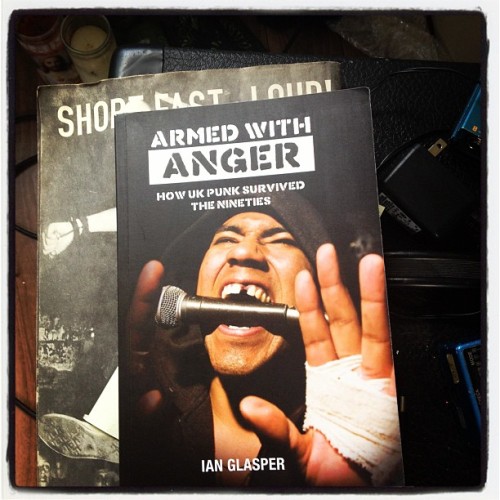
Thanks to a very nice person in Ireland i received a copy of Ian Glasper's latest book, Armed with Anger; How UK Punk Survived the Nineties in the mail today. Shank, the band i was in before moving to Canada, and the band that informed the earliest beginnings of The Endless Blockade has a segment in the book.
Because i've been around for a while i frequently get asked in band interviews about the differences between hardcore then and now, and the state of the scenes in both Europe and North America. It's hard to adequately explain it to people under the age of 30 and i generally just dismiss the question with some kind of "there were terrible bands then and there are terrible bands now and there were life changing, vital, incredible bands then and there are life changing, vital, incredible bands now" response.
The pieces i can't get across to others are how i situated myself in the world as a depressed, angry, anti-social youth compared to the more reasonable grown-ass man i am now, or how information travelled and how we decided which things were significant and meaningful before the internet explosion of the last decade (or more, depending on where you lived in the world).
Lately i've been thinking a lot about what makes my connection to underground (ie not concerned with money) music and the culture surrounding it so important to me. One of the main ways i've been framing the question to myself is "what are the differences and what are similarities in my approach as, say, a 24 year old - the age i was when Shank began - and as a 39 year old"?
I don't really have any answers to share with anyone else, except maybe privately among the other ex-members of Shank, Ebola and Sawn Off; my unholy trinity of 90s bands.
A part of me thinks this is my version of a mid-life crisis, where i second guess my motivations and frequently feel weird because i'm 20 years older than most people that come to see my band play in. Sometimes i look for reasons to give up making music. After Mission from God came out i told myself that as soon as i can take the music i hear in my head and accurately reproduce it for others i'll stop making music.
In a way i'd love for this to happen, but i know i'm never genuinely 100% satisfied with any thing i release.
The only thing the above rambling has to do with the Glasper's new book is that reading about, and consequently remembering, the roots of some of the things i do now now and what they meant to me a long time ago has only added fuel to the fire of these thoughts and ruminations.
I don't envy Glasper putting this book together; it can't be all things to all people. What he's chosen to include and exclude are not always the things i would have chosen to include or exclude. And that's the thing about the pre-internet era, there was no real consensus for deciding what was significant and meaningful in the way there is now.
What was important to a person in Newport was not necessarily transferable to a kid from Wigan or Sunderland. I think Glasper is 100% correct to include a band like Bloodshot in the book. Bloodshot only released a handful of tapes and left almost no legacy, but they epitomised the drive and spirit to get out there and create some kind of meaningful experience for themselves. They toured far more than any of my bands ever managed and all of my bands were "big shots" with crappy split 7"s that we could trade for other crappy split 7"s.
But at the same time i look at the contents and wonder why Nailbomb are mentioned only in passing and stuff like Bus Station Loonies, Whippasnappa, Chineapple Punks, or Demonic Upchucks get sections in the book. Part of this is because i don't place any value in those bands, but there are lots of bands in the book that i don't care for that are absolutely essential in telling the story of UK hardcore punk in the 90s.
Like i said, there wasn't really a way of achieving consensus in the pre-internet era on who was important beyond who had records out. Glaspers experiences are not going to be even remotely similar to my own
I suspect that for anyone who wasn't there there's only really a small segment of this book that will be interesting to read, but as much as i hate nostalgia (and i'm not really convinced this book is merely nostalgic) i'm really glad it exists.
And fuck, i know a lot of dead people. RIP Jas Tommer, Lobster and a ton of other people, some of whom i didn't know were dead until i flicked through the book.
A half arsed list off the top of my head of some records from that time and place that i think are essential:
Downfall - Not Your Fault 7" (1992)
Nerves/ Substandard - split 7" (1995)
Hard to Swallow/ Underclass - split 7" (1996)
Health Hazard - Not Just a Nightmare 7" (1993)
Wartorn - Banzai 7" (1994)
Urko/ Minute Manifesto - split LP (2001 - though both are most definitely 90s bands)
One by One - Fight 7" (1992)
Disaffect - An Injury To One Is An Injury To All 7" (1992)
Voorhees - Spilling Blood Without Reason LP (1994)
Kito - the Long Player LP (1998)
Ironside - Fragments Of The Last Judgement 7" (1993)
Stalingrad - Politics of Ecstasy 7" (1996)
Kitchener - The Price Of Progression 7" (1993)
Fabric - Body of Water LP (1994)
Because i've been around for a while i frequently get asked in band interviews about the differences between hardcore then and now, and the state of the scenes in both Europe and North America. It's hard to adequately explain it to people under the age of 30 and i generally just dismiss the question with some kind of "there were terrible bands then and there are terrible bands now and there were life changing, vital, incredible bands then and there are life changing, vital, incredible bands now" response.
The pieces i can't get across to others are how i situated myself in the world as a depressed, angry, anti-social youth compared to the more reasonable grown-ass man i am now, or how information travelled and how we decided which things were significant and meaningful before the internet explosion of the last decade (or more, depending on where you lived in the world).
Lately i've been thinking a lot about what makes my connection to underground (ie not concerned with money) music and the culture surrounding it so important to me. One of the main ways i've been framing the question to myself is "what are the differences and what are similarities in my approach as, say, a 24 year old - the age i was when Shank began - and as a 39 year old"?
I don't really have any answers to share with anyone else, except maybe privately among the other ex-members of Shank, Ebola and Sawn Off; my unholy trinity of 90s bands.
A part of me thinks this is my version of a mid-life crisis, where i second guess my motivations and frequently feel weird because i'm 20 years older than most people that come to see my band play in. Sometimes i look for reasons to give up making music. After Mission from God came out i told myself that as soon as i can take the music i hear in my head and accurately reproduce it for others i'll stop making music.
In a way i'd love for this to happen, but i know i'm never genuinely 100% satisfied with any thing i release.
The only thing the above rambling has to do with the Glasper's new book is that reading about, and consequently remembering, the roots of some of the things i do now now and what they meant to me a long time ago has only added fuel to the fire of these thoughts and ruminations.
I don't envy Glasper putting this book together; it can't be all things to all people. What he's chosen to include and exclude are not always the things i would have chosen to include or exclude. And that's the thing about the pre-internet era, there was no real consensus for deciding what was significant and meaningful in the way there is now.
What was important to a person in Newport was not necessarily transferable to a kid from Wigan or Sunderland. I think Glasper is 100% correct to include a band like Bloodshot in the book. Bloodshot only released a handful of tapes and left almost no legacy, but they epitomised the drive and spirit to get out there and create some kind of meaningful experience for themselves. They toured far more than any of my bands ever managed and all of my bands were "big shots" with crappy split 7"s that we could trade for other crappy split 7"s.
But at the same time i look at the contents and wonder why Nailbomb are mentioned only in passing and stuff like Bus Station Loonies, Whippasnappa, Chineapple Punks, or Demonic Upchucks get sections in the book. Part of this is because i don't place any value in those bands, but there are lots of bands in the book that i don't care for that are absolutely essential in telling the story of UK hardcore punk in the 90s.
Like i said, there wasn't really a way of achieving consensus in the pre-internet era on who was important beyond who had records out. Glaspers experiences are not going to be even remotely similar to my own
I suspect that for anyone who wasn't there there's only really a small segment of this book that will be interesting to read, but as much as i hate nostalgia (and i'm not really convinced this book is merely nostalgic) i'm really glad it exists.
And fuck, i know a lot of dead people. RIP Jas Tommer, Lobster and a ton of other people, some of whom i didn't know were dead until i flicked through the book.
A half arsed list off the top of my head of some records from that time and place that i think are essential:
Downfall - Not Your Fault 7" (1992)
Nerves/ Substandard - split 7" (1995)
Hard to Swallow/ Underclass - split 7" (1996)
Health Hazard - Not Just a Nightmare 7" (1993)
Wartorn - Banzai 7" (1994)
Urko/ Minute Manifesto - split LP (2001 - though both are most definitely 90s bands)
One by One - Fight 7" (1992)
Disaffect - An Injury To One Is An Injury To All 7" (1992)
Voorhees - Spilling Blood Without Reason LP (1994)
Kito - the Long Player LP (1998)
Ironside - Fragments Of The Last Judgement 7" (1993)
Stalingrad - Politics of Ecstasy 7" (1996)
Kitchener - The Price Of Progression 7" (1993)
Fabric - Body of Water LP (1994)
Subscribe to:
Posts (Atom)